thing 18: web applications

It has been a while since I seriously looked at Zoho Writer, preferring Google Docs mainly for the convenience (I always have Gmail open in a tab, so it’s easy to one-click open Google Docs from there). Zoho Writer seems to have more editing and layout tools, or at least, displays them more like MS Word.

I have been dabbling with web applications like document editors and spreadsheet creators mostly because I don’t like the ones that I purchased with my iMac. I probably would like the Mac versions more if I were more familiar with their quirks, but I’m so used to Microsoft Office products that remembering what I can and can’t do in the Mac environment is too frustrating. While Google Docs isn’t quite the same as Microsoft Office, it’s more-so than iWork ’08.

Playing with Zoho Writer, however, reminded me that I need to work around my Google bias. Particularly since the Zoho products seem to have the productivity functions that make my life easier.

thing 15: library/web 2.0

Librarians should be on the forefront of providing information services to users, but for some reason, we have a sizable contingent who seem to think that the innovations of the 70s and 80s are good enough for now. They’re the ones most often reacting negatively to anyone who mentions anything Library 2.0.

Anytime someone mentions some new web tool or gadget, and you think or say, “We don’t need that in our library!” or “What would you want to use that for?” stop for a moment. Do you use a computer in your daily library work? Do you use email to communicate with your colleagues and users? Have you talked to someone on the phone recently? These are all technologies that at some point in time, someone(s) didn’t think were needed in a library. They were wrong.

Maybe you don’t need to be on Twitter or Facebook to reach your users. (In fact, there have been many informal studies that indicate that students don’t want us in their social spaces.) But, you can use online social networking tools to expand your professional network, learn about what your colleagues are doing to improve services in their libraries, and share the things you are doing in your own library. Surely those are things that benefit the profession?

These things that people talk about as Web 2.0 are simply tools. You can choose how and when you will use them.

Library 2.0 has been used to describe a mindset that is open to exploring these tools and using them to enhance library services, but I think that has been a part of our profession for a long time. Library 2.0 was there when we began moving from card catalogs to online public access terminals. Library 2.0 was there when we opened up the stacks and allowed users to browse the shelves. Library 2.0 was there when we created free, circulating libraries that allowed anyone to access the knowledge they contained.

The philosophy of Library 2.0 isn’t anything new, we’re just using different words to describe what we already do best — exploring innovative ways to connect users with the information they are seeking.

thing 13: del.icio.us

When social bookmarking sites came on the scene, I was very resistant to using them. I had an organized system of bookmarking sites I visited regularly or sites that I needed to reference occasionally, and the del.icio.us format for displaying bookmarked URLs seemed cluttered and unorganized to me.

Fast-forward about five years, and we are now in a world where tagging and folksonomy are no longer scary new concepts (well, to those of us who have been reading, writing, and talking about them in the mean time). Tagging is now almost a requirement for a Web 2.0 service, and I use it frequently to keep track of things I want to go back to later, or to categorize what I am looking at.

About a year ago, I started using the del.icio.us extension for Firefox. At first, it was just a long list of the tags I used and had to be manually updated. Now it’s fully integrated with automatic syncing and the very useful search box (from the sidebar). It has nearly replaced the bookmark tool native to Firefox as my primary source of collected URLs that I find important to me. The best part is that I can access my bookmarks no matter which computer I am using, and this has come in handy on many occasions.

As I noted, I still use the bookmarking options within Firefox and do not send these things to my del.icio.us bookmarks, either. Mainly these are the sites I visit frequently, and I have them in my Bookmarks Toolbar folder so they’re just one click away. I have another folder of links to the tools that we use for on-call reference (Meebo, Ref Desk webmail, and LibStats), and I can tell Firefox to open all of the bookmarks in that folder with one click when my on-call shift begins.

One thing I’ve started doing with del.icio.us is creating sets of links that I can share with other people. I was inspired by a Computers in Libraries presentation on using del.icio.us for creating on-the-fly lists of resources for individuals and classes. If you’re interested, you can check out the list of podcasts I’m currently subscribed to.

Since I haven’t jumped on the Wordle bandwagon yet, and since it was a bonus activity for this thing, here’s the Wordle cloud for my del.ico.us tags:
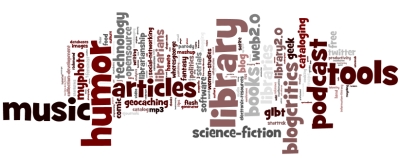

wordle cloud of my del.icio.us tags

day in the life of an electronic resources librarian

I am participating in the DILOLibrarian project today. This account is by no means comprehensive or reflective of every aspect of my workday, since each one is different depending on the volume of things demanding my immediate attention. However, it may be of interest to my non-ER librarian friends, as well as newly minted librarians and those who are considering this profession.

  • 8:45-9:00am Arrived at work, a bit late because my carpool driver and I miscommunicated about today’s plans. Turned on computer, got a cup of coffee, got a breakfast bar, and started this post.
  • 9:00-9:30am Read and responded to new mail that has accumulated since Thursday afternoon. Sorted messages that require more than a brief response into Information and To-Do piles.
  • 9:30-9:35am Generated a list of print + online and online-only science titles from our Ebsco subscriptions and gave it to the electronic resources associate, per his request. The serials associate and ILL associate both need this info, particularly since we converted as much as possible to e-only this year.
  • 9:35-10:15am Sorted through the various to-do lists (both email and Outlook Tasks reminders, as well as a few scraps of notes on paper) and worked on them from oldest to newest. One item was to call back a publisher, but their phone system has been screwed up since last Thursday, which I discovered when I tried again. Also, they gave me the New Jersey office number, not the (correct) New York office number. *headdesk*
  • 10:15-10:25am To-do email sorted and cleared from the pile. Reviewed email tagged “waiting for a response” and followed up on those. These are mainly notes from publishers with information regarding electronic resource subscriptions that had been requested by subject liaisons. I hang on to the messages until a decision has been made.
  • 10:25-11:00am Took a break from email to work on two of last week’s TechLearning tasks, which I completed just before Andy sent out the email announcing this week’s tasks. Filed those items away in my Outlook Tasks with due dates set for Friday.
  • 11:00-11:25am Processed new email that had arrived over the past hour. Took a short break away from the desk. Sent suggested training dates/times to a vendor for a new product we have purchased.
  • 11:25-11:30am Checked NASIG executive board email and responded to messages.
  • 11:30-11:40am Reviewed and assessed email in the “information” category. Cleared out some items that are no longer needed.
  • 11:40am-12:10pm Read through some of the issues on the stack of routed professional journals. I haven’t had any desk time lately, just on-call, so I’ve slipped behind on those.
  • 12:10-1:30pm Lunch. Ran errands that took longer than expected.
  • 1:30-1:50pm Processed new email (see a theme here?), answered an IM question from a colleague, and checked on my pals on Twitter & FriendFeed.
  • 1:50-3:00pm Finished up professional reading backlog.
  • 3:00-4:50pm Worked on checking a spreadsheet of electronic resource holdings against what is listed in Serials Solutions. Added/deleted titles, collections, and holdings as needed. Also, paused frequently to respond to email messages as they came in.
  • 4:50-5:15pm Browsed through the last couple of hours of tweets. Processed additional email.
  • 5:15-5:20 Checked NASIG executive board email again.
  • 5:20pm Decided I had done enough for today, so I typed this and… publish.

thing 12: Rollyo

Blogcritics used Rollyo for a while a couple of years ago, and I was never happy with the search results or the way they were displayed. It could have been some setting that BC used, but I assumed it had more to do with the way Rollyo works.

When I was at Blogworld last fall, I chatted with the folks at the Lijit booth for a while and made a note to take a look at their product when I got home. Apparently so did Phillip Winn, the Blogcritics Chief Geek, because not long after, Lijit replaced Rollyo as the site’s search tool. It’s worked out well.

Rollyo’s web search is powered by Yahoo Search, so I can’t see why I would want to use it as a general search engine. I think that Rollyo’s best value is as a search engine that looks at a specific collection of websites. This might be handy in a library if you have, for example, a number of different digital collections being served up from different domains or subdomains. With a Rollyo (or similar) service, you could build a single search interface for them. That is, if you don’t mind sending your users to a site that mixes in six paid links for each page of ten results, in addition to side-bar advertisements.

thing 10: image generators

For this assignment, we are asked to look at several different online image generators/editors. The first is fd’s Flickr Toys, which I have played with in the past. However, I am surprised to see how many nifty tools they have now — far more than the memes that have invaded my online social network. I will probably find use for CD Cover, Motivator, and Lolcat Generator. (If you’re a new WordPress user and you want a spiffier header than the default, check out the Blog Header tool.)

Dumpr seems to be similar to fd’s Flickr Toys, except that a handful of the more interesting tools require a pro membership to use, which does not impress me. If I’m going to pay for something like that, I might as well learn how to do it myself in Photoshop or GIMP.

BE NOT AFRAID - CEILING CAT SENT ME

thing 9: finding RSS feeds

Part of why I have so many RSS feeds in my reader (234 at the moment — picked up three more this week) is because it is so easy to subscribe to things I run across in my day-to-day online activity. I’m currently using the Better GReader plugin for Firefox, which compiles some of the best Greasemonkey scripts for Google Reader. One thing I really like about it is the “Auto Add to Reader (Bypass iGoogle Choice)” feature, which saves me a few clicks.

This particular assignment asks us to make use of directories like Technorati and Feedster to locate feeds we want to subscribe to. I’m going to not do that, since I already have more to read than I have time to read. In any case, those tools have not been particularly useful to me in the past. I tend to find new feeds through links from the ones I’m currently reading.

thing 8: RSS

The first part of the assignment is to set up a feed reader. I’ve used a variety of feed readers, from desktop readers to online readers, and by far I prefer the online readers. The mobility alone makes them a winner, since I read feeds using several different computers. Here’s my current OPML file, which has been slightly edited and reorganized for public consumption (i.e. you don’t need to know about my ego feeds).

Over the years, have had to cull my feeds periodically. There are several news sites or blogs that I would love to be able to keep up with, but I don’t have the time to process the volume of content they generate on a daily basis. Currently, I have about 231 subscriptions, several of which are for dead feeds that I haven’t cleaned out yet.

I am perpetually behind on reading all of my subscriptions. There are a few that I hit regularly, but the rest are saved for times when I need to take my mind off of whatever problem I am working on at the moment. With this many feeds, RSS is a time shifting or bookmarking tool, and I’m okay with that. Twitter has become my source for the latest OMG news.

six word memoir

I have been tagged by a meme. That never rarely happens.

The rules:

  1. Write your own six word memoir
  2. Post it on your blog and include a visual illustration if you’d like
  3. Link to the person that tagged you in your post and to the original post if possible so we can track it as it travels across the blogosphere
  4. Tag five more blogs with links
  5. And don’t forget to leave a comment on the tagged blogs with an invitation to play!

tired and worried

My Life as an Unwilling Nomad

I am tagging my fellow TechLearning companions who have their blogs linked from the site at the moment: Andy, Betty, Carol, Catherine, Crista, Leigh, Linda, and Rochelle.

I am also tagging you. Yes, YOU. Do it.

thing 7: technology

I first thought I might write about my new iMac and falling in love with the OS, but instead I’m going to write a bit about a new mashup tool that a colleague introduced me to today. It’s called Widgenie, and it takes Excel or CSV files and makes nifty graphs and charts out of the data.

I’ve done this several times using Excel, and often I find that there are too many things to tweak to do just a quick and dirty graph or chart for a meeting/presentation. With Widgenie, I found the opposite to be true. Cell formats are limited to text, number, and date/time, and for the life of me, I could not get it to show data for resources over a period of time (i.e. one year of use stats for a collection of databases).

That being said, the tool is in Beta, so it’s possible that greater functionality will come. For now, though, it’s probably useful for only simple graphs and charts, such as this: