Learning 2009: Kindles, Sony Readers, iTouches, and iPhones

Presenters: Andy Morton, Olivia Reinauer, and Carol Wittig

The presenters brought three netbooks, three Kindle 2s, a Sony Reader, and an iTouch to pass around for attendees to handle. These are from the small collection recently purchased for experimenting with library and course use. They are hoping to get feedback or discussion about how the attendees think that they will impact classroom instruction.

While the Kindle is not likely to be very functional for traditional library services, rumors of the next version indicate that it will be more functional for textbook, newspaper, and media uses. This will definitely impact classroom activities. You can mark up text with notes, and it’s fully searchable, which could be handy for finding the notes you made to yourself.

Sony Reader uses the same kind of screen as the Kindle, but is smaller due to the lack of full keyboard. However, unlike the Kindle, it has a touch screen (and a stylus). There are expandable memory cards that can handle digital photos (in black & white) and audio. Like the Kindle, you can take notes on it. They’re also working with OCLC and Google Books to expand access to resources.

The iTouch and iPhone can make use of the Kindle software, and there are many other ebook apps as well. They are also useful for accessing internet applications on the fly. [Side note: I think I like this the best – one-handed touch-screen reading and much lighter than the dedicated ebook readers, but with a much larger screen than my old PDAs and brighter text.]

Netbooks are relatively inexpensive and easier to transport than full-size laptops. They’re certainly popular at conferences.

Learning 2009: Image Resources for Teaching

Presenters: Jeannine Keefer and Crista LaPrade

Keefer provided the attendees with a brief overview of licensed images. Specifically, ArtStor and why it would be used in the classroom (mainly art historians). There are also many free or Creative Commons licensed resources for images:

  • Flickr – range from amateur to professional, free to fully copyrighted
  • Picasa – similar to Flickr, but less communal
  • Google Images – search across the web
  • Google Earth – geotagged photos for specific locations
  • Creative Commons – search across several sites
  • MorgueFile – stock photography
  • OpenPhoto – stock photography
  • TinEye – reverse image search engine for finding more like the one you have
  • Cooliris – browser plugin for quickly flipping through images on various sites
  • Social networks like Facebook & MySpace

LaPrade and Boatwright Library’s Digital Production Services does all of the digitization and scanning for the library as well as scanning for faculty who need to convert analog images to digital for non-art classroom purposes. Non-presentation uses for this service (ideas beyond PowerPoint) include creating reference posters for students and images supplementing faculty publications (within copyright). Unfortunately, faculty will have to find their own storage (DVDs, flash drives, etc.) and delivery options, as DPS currently does not have a server for storage and delivery.

There are many resources you could use to share images in the classroom, including Blackboard and ArtStor, but also free image storage/sharing resources or your own web pages or blog. However, there are several factors to consider, since these can also be tools for managing the images: purpose, platform, ownership, collection size, image manipulation, metadata, budget, tech support, data integrity, file types, and presentation tool. Some possible solutions include Adobe Bridge (with the full version of Photoshop), Extensis Portfolio, Flickr, and Picasa.

(Side note: I think that many of the folks in the room were expecting to have a discussion of how faculty are actually using images in their teaching, and perhaps less about the tools that can be used to do so.)

Learning 2009: Keynote

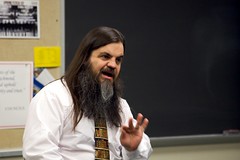
Speaker: Bryan Alexander

He is interested in how social media is used to disseminate information. Shortly after CDC set up a Twitter account, many folks started following their updates with information. Many people and organizations created Google Maps mashups of incidents of H1N1. Alexander gathered examples of the variety of responses, and he doesn’t think that any institution in higher education is prepared to discuss or teach on this use of social media and how to critically respond to it.

Web 2.0 Bullshit Generator:
1. Click the button.
2. Watch the bullshit appear in the box.

Twitter has taken off among an unusual demographic for social media: adults with jobs. The news of the plane that landed in the Hudson was scooped by a Twitter user. It’s now one out of many news sources, and soon there will be better ways of aggregating news information that includes it. The number of individuals arrested for blogging (or microblogging like Twitter) has gone up dramatically in recent years. These tools are important.

LinkedIn: least sexy social media site on the net. However, they are making a profit! Regardless of how spiffy it could be, people are still using it.

Scott Sigler shout-out! Future Dark Overlord gets a mention for being the first podcast novelist to break the NYT bestseller list.

Recommended reading — The Wealth of Networks: How Social Production Transforms Markets and Freedom by Yochai Benkler

photo of Bryan Alexander by Tom Woodward

Before Web 2.0, you had to know HTML, have FTP access, and server space somewhere. The learning curve was high. With Web 2.0, it’s easy to create, publish, and share microcontent from a variety of free or open sources. The learning curve is much lower — barriers to access are torn down in favor of collaboration and information dissemination.

2.0 conversations are networked across many sites, not just in one or two locations like 1.0 or print. The implications for how we teach students is huge!

Mashups are great ways to take data or textual information and create visual representations of them that enhance the learning process. For example, Lewis & Clark University created a Google Maps mashup of the locations of the potters in their contemporary American pottery collection. This map shows groupings that the text or images of the pottery does not easily convey.

Alexander used the blog format to publish a version of Stoker’s Dracula, which was easily adaptable to the format. It took little time, since he had the text in a document file already (he was preparing an annotated version for print). This brought interested readers and scholars out of the woodwork, including many experts in the field of Dracula research, who left comments with additional information on the entries.

If you’re not using technology in teaching, you’re not Luddite — you’re Amish.

According to Google Labs’ Trends tool, “Web 2.0” is going down as a search term. That doesn’t mean it’s going away. Rather, it means that it’s becoming “normal” and no longer a new technology.

The icon for computing used to be the desktop, then it became the laptop. Now it has exploded. There are many devices all over the map, from pocket size to much larger. Wireless means nothing anymore — it’s defining something by what it is not, and there are a heck of a lot of things that are not “wired.”

Mobile computing is not a panacea — there are problems. The devices are too small to do serious editing of video or audio. The interfaces are difficult for many users to do much more than basic things with them.

Information on demand at one’s fingertips is challenging for pedagogy. Students can be looking up information during lectures and possibly challenging their teachers with what they have found. Backchannel conversations can either enhance or derail classroom conversations, depending on how they are managed by the presenters, but one main advantage is that it increases participation from those who are too shy to speak.

The pedagogical aspects of video games are finally making their way into higher education scholarship and practice. The gaming industry is currently more profitable than the movie or music industries. We need to be paying attention to how and what games are teaching our students.

reducing waste in the paperless society

On the way back to my office after mailing off my passport renewal forms (w00t!), I passed by a display in the Campus Forum. There were long tables set up on a tarp, with a row of 50 gal. plastic bins behind them, marked with different kinds of recyclable materials. Next to the tables and bins were about 10 full trash bags, presumably collected from around campus, and there appeared to be a truck with possibly more bags located nearby. Three men stood at the tables in biohazard suits and gloves, and wearing protective goggles. They were carefully sorting through open trash bags, checking the numbers on plastic containers, and sorting the contents into the appropriate recyclable or trash bins.

When I arrived here, I was surprised by how recycling-friendly this campus is as compared to others where I have worked or studied. Even in the eco-conscious Pacific Northwest, I did not see as many recycling bins in buildings (or at least the library) as I do here, nor have I heard any other head of waste management on a campus speak as passionately about reducing the level of waste.

I try to recycle as much as I can and throw away as little as I can, but unfortunately, I’m addicted to some things that come individually wrapped, which ends up creating a lot more waste than if I bought in bulk or chose items with less packaging. Still, including cat litter, I end up filling only one kitchen trash bag every 7-10 days, which is not too shabby for a single person.

Even so, as I scan the contents of the top of my office desk, I see a lot of paper from printouts that I could have kept in digital form. Several items are things that need to be converted to hard copies (license agreements needing signatures and whatnot), but many are simply for my information and will eventually end up in the recycle bin.

Last week, we talked about our “paperless society” in the Library Tech Team meeting. One of the things we tossed around was the idea of purchasing a bunch of small laptops of the EEE PC variety for library staff to use in meetings or other places where they need to bring documents or take notes, instead of having a bunch of printouts. I don’t know if that would fly very well. Personally, I wouldn’t want to have to keep track of which machine (desktop or laptop) holds the document I need.

However, my work desktop is a laptop that stays docked most of the time, unless I’m needing to work elsewhere, like at a conference. I’m not using it to the fullest for mobile computing because, honestly, it’s annoying to have to organize the screen space again when I return it to the dock and am now using a 24″ monitor rather than the built-in 15″ laptop screen. That’s a lame excuse.

For the month of November, I’ve committed myself to bringing only my laptop to meetings. No more papers, no more clutter to file in manila folders and then forget about. And, as an added bonus, I don’t have to spend extra time deciphering my handwriting.

productivity tools from MS and Google

I’ve been enjoying all the benefits of having Outlook as my primary work email and calendar tool for the past year. After three years of dealing with the disaster that is Novell GroupWise, it’s lovely to finally have a tool that does what I need it to do.

However, for my personal stuff, I am a big fan of Gmail and other Google tools, so I was a little sad to give up my Google Calendar, among other things. All that has changed in the past week now that I’ve discovered the GCal/Outlook syncing program. Right now, I have it only going from Outlook to GCal, but that may change in the future.

Another awesome tool that I’ve implemented this week is the Google Calendar gadget available from Google Labs. This puts my upcoming appointments in the sidebar of Gmail, and pings little reminders if I have Gmail open. Outlook takes care of this at work, and I’m loving having this functionality in my my non-work hours without having to maintain two separate calendars.

The other Google Labs gadget that is made a surprising impact on my productivity and organization is the Remember The Milk task management tool. I’ve been using RTM to keep track of my review assignments, but I hadn’t found a need for it for other to-do things since I use the Tasks feature of Outlook for work stuff. However, when my emails to personal address with things I needed to remember to do began to pile up and clutter my inbox, I decided it was time to implement a real to-do list. With the Gmail integration, it’s now all in one place, just like with my work stuff in Outlook.

reflections on LITA 2008

This was the first conference I have attended in many years where I did not know hardly any of the other attendees. Aside from my two colleagues and three other attendees, I had little more than a passing conversation with no one else at the conference prior to my arrival in Cincinnati. So, the professional network re-connection aspect was not as prominent for me as it has been at other events. Unfortunately, my shyness also kicked in, which meant I was not as effective in building new connections as I could have been.

The hotel was impressive. The Hilton Netherland Plaza is a historic building in downtown Cincinnati. It opened in 1931 and is a National Historic Landmark, which means that despite the renovations, they have attempted to preserve as much of the original features as possible, including the impressive French Art Deco architecture and art in the main meeting rooms and restaurants. I somehow ended up in a room on the top floor (29th), and it even had a lovely view of the city rather than the typical office building exterior wall view that is most common in downtown hotels.

The sessions I attended were mostly informative, and I particularly liked the Five-minute Madness format — eliminated a lot of the stuff that irritates me in most presentations. However, in general, I was not as impressed with the sessions nor did I take away as much from them as I have from LITA sessions at ALA Annual & Midwinter. I’m not sure if it was the mix of people involved or the presentation topics, but it was a little disappointing. Unfortunately, my cold had kicked into high gear by Sunday, so I ended up skipping the last concurrent session and closing keynote in favor of walking around downtown Cincinnati for some fresh air and sunlight.

I’m glad I attended LITA Forum, because I have been wanting to go for several years now. However, I think that in the future my presence there will be only an occasional thing, most likely when it occurs in locations within driving distance. The technical and interactive side of librarianship that interests me is mostly covered by the sessions at Computers in Libraries, so I think I should expand my horizons to other aspects of librarianship with my valuable and precious conference attendance time and resources.

LITA 2008: Web Site Redesign – Perspectives from the Field, Panel Discussion

Panelists: Robin Leech (Oklahoma State University Libraries), Amelia Brunskill (Dickinson College), Edward M. Corrado (Binghamton University), Elizabeth Black (Ohio State University Libraries), Russell Schelby (Ohio State University Libraries)
Moderator: Mary LaMarca (Dartmouth College Library)

Black & Schelby:

When they began the project two years ago, the website was large and maintained by 100 content submitters, most of whom had limited coding expertise. Selected and implemented a Web Content Management System, and created a team of technical experts with both coding and project management skills. Black consciously focused on team development activities in addition to the projects the team worked on.

The team made a commitment to security, usability, maintainability, and data preservation of the website content. As a part of the data preservation, they were careful to document everything from architecture to passwords.


Brunskill:

Four years ago, Academic Technology, Library, and Information Services merged to become one division. The website was initially integrated, but then user feedback caused it to be broken out into separate divisions again. After a few years, the library wanted to make some changes, so they did a usability study, which resulted in some menu and vocabulary changes. Then, they began to plan for a much larger redesign.

To solve the communication problem, they set up a blog, charged unit representatives to report back to their units, and circulated usability data among all library staff. The usability studies also served as a buffer for touchy political situations, since the users are a neutral party.


Leech:

Developed two teams. The usability team informed the web redesign team, with only the library webmaster serving on both. Suggested that usability team read Don’t Make Me Think by Steve Krug.


Note: I had to leave early because I could not stop coughing. The hotel HVAC was not playing nicely with my cold.

LITA 2008: Five-minute Madness

Call for presentations went out a few weeks ago, with the idea of gathering fresh content. Presenters have five minutes each.

Incorporating ICT into a New Vision for Caribbean Libraries
Presenter: Gracelyn Cassell

Delivers distance education for the West Indies — looked at the library situations in 15 countries. The libraries have inadequate budgets, limited facilities, small and dated collections, poor technology, under-trained staff, and inadequate services. However, the libraries are eager for dialogue, willing to listen to suggestions, strong interest in training, and the librarians are craving refresher courses.

The university has capacity for training, as well as tele- and video-conferences. Need to use the resources of the university to deliver training and services for the regional libraries.

How can LITA help? Provide on-site technical support (in the winter, of course).


Using Delicious to Select Teaching Materials Collaboratively
Presenter: Emily Molanphy

Sakai is their CMS (open source). Like it, but needed more multi-media and less PowerPoint. Asked library for help.

Wanted the links to the resources be easy to share, and to be able to annotate the links. Faceted using tag bundles, but the most important aspect is that the recipient can choose their access point.

Known issues: Need to share password for a single account. For:username is too limited because the tags and the description are stripped. Faceting is flawed because everything is listed alphabetically.

Good way to supplement personal meetings.


Help Systems Based on Solr
Presenter: Krista Wilde

Solr is an open-source software that serves as a front-end access point to a database that returns queries in XML. Created a Solr instance specifically for help, and then created webforms for adding and modifying web pages with details about what pages or topics the help document is related to.

Wanted to make the help searchable and dynamic, to allow non-technical staff members to update and modify the pages, and using their tools to support their tools (they use Solr quite a bit).


RFID Self Checkout User Interface Redesign
Presenter: Robert Keith

Were using a self-check machine before, but felt that six steps were too many and were frustrating. Interface was too busy, small text (and lots of it), distracting animations, and the public & staff did not like it.

Re-designed with larger (briefer) text, uses audio commands to prompt user, and automatically prints the receipt (and thus not resulting in hung patron records). The result is that they have increased self-check use by 10% for adults and 30% for children.


The Endeca Project at Triangle Research Libraries Network
Presenter: Derek Rodriguez

March 2008 – launched Serach TRLN, a union catalog for the network. In August, they launched local interfaces at three universities. Licensed Syndetics data, and are indexing the table of contents. Plan to tune the search and relevance ranking, add new indexes, shopping cart, and ingesting non-MARC data.


Handheld Project Scope at Penn State
Presenter: Emily Rimland

Impetus for the group: iPhone lust. Librarians thought that mobile devices could support roving reference. Necessary for a library made up of three buildings mashed together. Would also be useful in faculty liaison activity, and to test the accessibility of their web-based resources.

The team of librarians and IT staff mapped the uses to the requirements and the requirements to the mobile devices. As it turns out, none of the four that fit were the iPhone: Nokia N-810, Sony Vaio UX-490, Fujitsu Lifebook, and OQO. (Some they were able to borrow from IT staff.)

The testing showed that there was a learning curve to using each device. The best was the Fujitsu Lifebook.


Unmanned Technology Projects
Presenter: Mike McGuire & Suzi Cole

They had big plans & user expectations, and consortial pressure to be an equal partner, but their limited staff did not have time to do or learn more. And, ultimately, a lack of coordination which lead to frustration, stress, and potential burnout. Solution: Library Technology Working Group that includes key players (library and IT), monthly meetings, and a wiki that tracks projects, meeting minutes, timelines, and what’s new.

Communication has been great. They have clear priorities and resource needs and a place to organize and share documentation. The results have been unexpectedly positive.


Texting at the Reference Desk
Presenter: Keith Weimer

Single service desk for phone, email, and chat, as well as walk-up reference. Wanted to reach users at new points of need, so investigated SMS. Upside Wireless is a Canadian company that provides SMS-to-email and a local phone number. But, it’s expensive to develop and maintain.

Did a soft rollout, with a link on the web page and table tents. A few months later, did a hard rollout with larger promotion around campus, including posters. After the hard rollout, the use has spiked. Has been used mostly for short queries like circulation info and hours, but about a quarter of the use was for reference type questions.

May move to AIM Hack, which is cheaper.


Digital Past: Ten Years and Growing
Presenter: Katy Schlumpf

Local history digitization project focusing on Illinois records, but the scope may need to be widened to encompass other collections housed in the system. Struggling with what to do for the future, particularly with tight budgets.

LITA 2008: Hi-Fi-Sci-Fi-Library: Technology, Convergence, Content, Community, Ubiquity and Library Futures

Presenter: Michael Porter, WebJunction

Hi-fi is usually associated with audio equipment, but fidelity is very much related to our work: interoperability, compatibility, quality of the document, etc.

When you distill what libraries are and what they do, it comes down to content and community, and this is what libraries will still be in the future. Star Trek’s LCARS stands for Library Computer Access and Retrieval System — even those folks thought that the “library” would be that integrated into everything in the future.

The line between hardware and software is blurring now, particularly with software that can emulate hardware. Costs for technology are decreasing, computing power is increasing, and battery life is getting longer. There are newer and better methods of creating content, and competition for content provision is getting fierce. And, you can find community all over the Internet.

The Google Android phone is actually just software that is open source and can be used by any wireless phone manufacturer, and can be hacked by any coders who want to enhance the functionality. The Bug is hardware that comes in components that can be hooked together to created whatever you need, like a digital camera or portable computer.

Audio test for the video section – Rickroll!

The Time Machine: Computer interface in the library is represented as a human hologram. Also, the reference interview was… a bit rude. Books were represented as being behind preserved glass, and the students carried hand-held pads to download content.

Star Trek IV: Human-computer interaction in the Star Trek future uses voice recognition, but in 1985, that wasn’t possible.

Star Trek IV: Spock is working with three monitors, each presenting different problems. He uses a mixture of voice and tactile inputs to respond.

Futurama: 1000 years in the future, we will still have books and the Dewey Decimal System.

I, Robot: “ban the Internet to keep the libraries open”

Futurama: Will be able to get physical things from the Internet. We already have printers that can print in 3-D!

How William Shatner Changed the World: TNG wanted us to get the notion that we should not be afraid of technology.

Minority Report: Manipulates computer visuals using hi-tech gloves.

How William Shatner Changed the World: Modern-day physicist uses his knowledge to examine the realistic possibilities of Star Trek.

Zardoz: Ring that projects data.

Futurama: Librarians hold the keys to power, but it doesn’t always appear that way.

LITA 2008: Portals to Learning – What librarians can learn from video game design

Saying “this is how you type in a text box” is like saying “let’s talk about breathing today.”

Speakers: Nicholas Schiller (Washington State University, Vancouver) and Carole Svensson (University of Washington, Tacoma)

We’re not getting any younger, but our students are. We think of new technologies as ways to deliver old ideas, but really we need to mix it up.

Gaming literacy is a way of looking at the media of video games and interactive media through the eyes of the designers and the players. It’s not helpful to view this as a zero sum game – it’s not about competing with reading literacy.

Games are now mainstream media. They are more significant to our students than they were for the generations that came before them (i.e. most of us librarian types). Video games are viable competitors with movies, television, and popular music. All indicators show that the population of gamers is only going to get larger over time.

We don’t need to be advocates of games in order to understand our users that are gamers. We need to be literate in this new media in order to connect with and serve those users. If we don’t understand them, then we are not equipped to either critique or use gaming media.

How do we think intelligently about “childish” things? Separate the content from the format and use the analytical tools we already know (like Deb Gilchrist’s 5 questions for outcomes-based design or Adler and Van Doren’s How to Read a Book) and apply them to new media.

Think about the experiences of using character based interfaces and a GUI like III’s Millennium. The two experiences are very different, but the content is the same.

The point of studying gaming behavior is rarely the context of the games. Games are complex information systems. They must teach players to evaluate information and make informed choices in order to succeed. Games that fail to do this well do not sell. Being frustrated is not fun.

We want students to understand that their information needs are complex and require complex tools like scholarly bibliographic indexes in order to meet those needs. However, most of our users think that their information needs are simple and instead gravitate towards simpler tools like Wikipedia and Google.

MMORPGs like World of Warcraft (WoW) have an emphasis on collaboration and apprenticeship. Working with friends meant that the experience was less frustrating as a new user. In library instruction classes, allowing students to self-select their groups for team exercises will guarantee groups that are more comfortable with each other from the get-go.

Collaborative games also de-emphasize authority distinctions and emphasize peer knowledge. Peers are the best sources for information in games, rather than the help document or support tech. The average time that a peer responded in WoW was 32 seconds. What’s your IM/email reference response time? Also, for peer knowledge to work well, we need to have FAQs or knowledgebases that are built on by student knowledge over time.

In the games, each level builds on the next one, which is like how we try to teach library stuff. However, in the game, it tends to be more fun. Game players are not tempted to skip forward because the games are structured so that you only see the part of the world that you’ve mastered. When game players get to the point where they need additional information, it’s desired rather than being overwhelming. In teaching library tools, focus on fewer things until users get comfortable with them, and then show them more.

Players build resources for helping each other and developing community. Do we see that happening with EBSCOhost? No.

When you fail in WoW, you know what to do. Find someone to help you or look for information in the user-created content online. When students fail in the classroom or library, do they know what to do? Building expertise and community allows them to understand that keeping at it will result in success.

Gating is a mandatory pause in the action of a game that requires demonstration of skill acquisition. In the classroom, design research assignments to require identification of and reflection on research choices, or create annotated bibliographies.

Why doesn’t Laura Croft obey Professor Van Croy? Players learn that sometimes if they do what the instructions tell them to not do, they get rewarded. By exploring the game outside of the small boundaries, they learn more about what is there. In the classroom, this translates to discovery based learning. Pique their curiosity and then let them discover the advanced tools in a resource.

As in higher education, the more you “level up,” the more you need help from experts. Experienced librarians are better equipped to say “I don’t know” and refer the information seeker to experts. With each level of research, you have to keep at the process until you find the answers you seek.

If we can help our students see when they’re playing games, they are actually functioning on a fairly high level on Bloom’s Taxonomy. Then, we can help them see that their complex and involved academic research is not only something they are capable of doing, but it’s something that they’ve already done while playing games, as long as we keep our focus on the process of games and not the zombies and vampires.

Students don’t have trouble figuring out how to use our tech, but they don’t understand why they would want to use it. So, instead of teaching them how to use the catalog, we should be instilling in them the motivation to use it and they’ll figure out the quirks on their own. Saying “this is how you type in a text box” is like saying “let’s talk about breathing today.”